Structural Alignment on the Plate
Assess the plate before considering the color in the glass. Successful pairings rely entirely on chemical interactions. Identify the dish's dominant acid, its fat level, the protein's texture, and any aromatic bridge supplied by seasoning or sauce. Acidity earns priority because it clears oil from the palate and keeps the next bite vivid. Body matches texture so neither side overwhelms the other. Shared compounds such as smoke, herbs, mushrooms, or red fruit then refine the final selection.
Fresh, dry table wines commonly sit near pH 3.0 to 3.8. Perceived freshness also depends heavily on total acidity, residual sugar, alcohol, and serving temperature. Relying on pH alone provides an incomplete picture for selecting the pairing.
Testing the Structural Match: Taste the wine alone, take one bite containing fish and sauce, wait 5 to 10 seconds, and taste the wine again. Increased bitterness, a metallic flavor, or a suddenly flat finish indicates a structural conflict.
Why Heavy Pours Clash with Ocean Catch
Separate two distinct effects that often get compressed into a single rule. Dissolved iron in wine catalyzes the oxidation of unsaturated seafood lipids. This specific reaction produces a fishier, metallic aftertaste. Pronounced tannin simultaneously binds with salivary and fish proteins, making the mouthfeel drier and bitterness more obvious. Diagnose the catalytic metallic aftertaste separately from tannin-driven dryness before blaming red wine as a category.
Cabernet Sauvignon and Syrah carry high risks when heavily extracted. Sensory work on wine and seafood associates iron concentrations above roughly 2 milligrams per liter with stronger fishy aftertastes. Ordinary wine labels omit dissolved iron metrics. The risk rises sharply with oily fish and a young, firmly extracted red. Tasting the combination for 20 to 30 seconds usually reveals the metallic aftertaste after the initial fruit fades.
Low tannin offers no proof of low iron. An unusually metallic bottle may still clash with oily seafood despite belonging to a light-bodied variety. Sensory mapping gives reliable baselines, but sensitivity to metallic compounds differs from palate to palate.
Chilled Vintages for Dense Cuts
Select the bottle based on its internal structure. Pinot Noir excels when fresh, minimally oaked, and driven by red cherry or earthy notes. Gamay contributes bright acidity and little gripping tannin. Frappato adds floral, strawberry, and herbal tones without heavy weight. Match these wines to fish with enough density to carry red-fruit flavor. Salmon's fat and swordfish's muscular flake provide the necessary foundation.
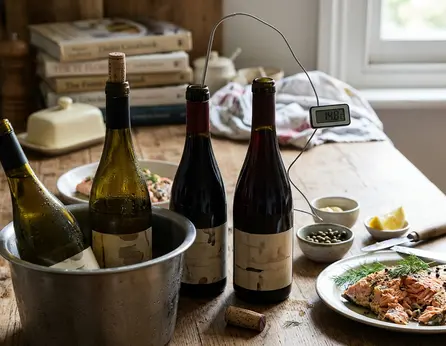
Grilled salmon, tuna, or swordfish cuts approximately 2.5 to 4 centimeters thick handle these profiles beautifully. Favor bottles somewhere around the 12 to 13.5 percent alcohol range. Avoid versions described as heavily oaked, densely extracted, or firmly tannic.
Temperature Control for Reds: Serve a light red at 12 to 14 degrees Celsius. The cooler pour suppresses alcohol heat and sharpens perceived acidity. A bottle starting near 20 degrees Celsius generally needs 25 to 35 minutes in a 4-degree refrigerator to approach a lightly chilled serving range. Check the temperature after 25 minutes.
Matching the Sear and the Sauce
Treat the cooking method and sauce as part of the protein. Steaming preserves saline delicacy and points toward white wine. Steamed sole with lemon does not inherit the red-wine logic that applies to a seared swordfish steak under a mushroom reduction. Pan-searing, wood-fire grilling, and blackening create a browned crust, smoke, pepper, and roasted aromas that a light red echoes perfectly.
A 2.5 to 3-centimeter tuna or swordfish steak develops a red-friendly crust after roughly 2 to 4 minutes per side in a thoroughly preheated pan. The exact finish depends on the fish type and desired doneness.
Building the Aromatic Bridge
The sauce settles the final choice. Earthy mushrooms support Pinot Noir. For a mushroom reduction, sauté the mushrooms until their released liquid evaporates. Expect that to take about 8 to 12 minutes before adding stock or wine. The evaporation concentrates the earthy aromas that connect with the wine.
A savory soy glaze suits juicy Gamay. Brush a soy-based glaze during the final minute or two of cooking. Its sugars scorch easily before a thick fish steak finishes cooking. Pair the resulting savory-sweet crust with chilled Gamay. Blackened seasoning and wood smoke increase bitterness alongside aroma. Keep the selected red cool at 12 to 14 degrees Celsius and choose restrained oak to prevent stacking char on top of char.
Evaluating the Final Dish
Make the pairing decision in three passes. First, classify the fish as delicate, oily, or steak-like. Next, identify whether the preparation is pale and gentle or browned and smoky. Finally, evaluate whether the sauce points toward citrus, cream, earth, soy, or wine. A delicate fish with lemon remains a natural white-wine case. A firm fish with seared edges and a mushroom or savory glaze gives a high-acid red room to perform.
At the table, compare one bite with sauce and one bite without it over a 30 to 60-second tasting sequence. If the sauce determines which sip tastes more complete, pair to the finished plate rather than to the fish species. Before opening a red, verify three operational cues: a serving target of 12 to 14 degrees Celsius, restrained tannin, and a preparation containing sear, smoke, earth, or a savory reduction.
When you plate your next wood-grilled tuna steak, will you reach for the familiar white, or will you pull a chilled Gamay from the cellar to match the char?