Preparing Your Blind Tasting Environment
Label-first tasting reinforces associations between price, appellation, and expected quality. Repeated often enough, those associations replace independent sensory judgment. If you rely on labels before tasting, your palate remains permanently biased, preventing you from developing true sensory accuracy. To build a reliable palate, you must remove every identifying clue—wrap bottles completely in aluminum foil or unmarked paper bags secured with tape.
Prepare the concealed flight 10-20 minutes before tasting so bottle handling and room entry do not reveal which sample was poured where. Set glasses on an odor-free surface under neutral white light, with at least one sheet of uncoated white paper available for every two tasters. Glassware selection dictates the accuracy of your aromatic assessment. Use identical, polished tulip-shaped glassware to ensure the aromatic delivery remains consistent across all samples.
Temperature control provides the optimal baseline for evaluation. Serve still white wines at 8-12 degrees Celsius and most still reds at 15-18 degrees Celsius. A wine poured much colder can suppress aroma and exaggerate tannic hardness. Use pours of 60-75 milliliters, which leave enough empty bowl space for swirling without consuming a full tasting portion.
Evaluating the Visual Clues
Begin with sight because visual evidence establishes plausible boundaries without exposing the palate to flavor. Hold the stem, tilt the glass to roughly 45 degrees over stark white paper, and compare the core color to the rim. View the glass from about 20-30 centimeters away under a neutral lamp. Colored tablecloths and warm amber bulbs distort rim assessment.
Allow 5-10 seconds after tilting for sediment or haze to become visible before recording clarity. For red wine, record both the core and rim separately. Examples include a purple core with a ruby rim, a ruby core with a garnet rim, or a garnet core with a tawny rim. Deep, opaque cores often suggest thicker-skinned grapes or warmer climates. Grape skin thickness, maceration length, fermentation temperature, and extraction choices can produce a dark wine from a comparatively cool site.
Preventing False Viscosity Reads
Evaluate viscosity without jumping to immediate conclusions. After one controlled swirl lasting 3-5 seconds, watch the inside wall for 10-15 seconds and describe the tears as fast, moderate, or slow rather than assigning an alcohol level from appearance alone. A warm, high-alcohol wine can produce slow tears even when it is fully dry, so reading visible legs as proof of sweetness creates a common false deduction.
Deconstructing the Aromatic Profile
Smell in passes so the strongest aroma does not dominate the entire assessment. Take two or three short sniffs from the stationary glass, record aroma intensity and obvious faults, then swirl and repeat. Use sniffs lasting roughly 1 second, then pause for 10-15 seconds before the next pass to reduce rapid olfactory adaptation.
Categorize aromas systematically. Start with primary aromas, encompassing the fruit, floral, and herbal notes derived directly from the grape. Record specific fruit condition as well as identity. Fresh blackberry, stewed blackberry, and dried blackberry imply different ripeness and development signals. Move to secondary aromas like baking spices, vanilla, or butter, which indicate specific winemaking techniques like oak aging or malolactic fermentation.
Timing the Aromatic Evolution
Swirl for 3-5 seconds and bring the glass to the nose immediately. Highly volatile aromas can change within the next 30-60 seconds. Complete the first aromatic pass within 2-3 minutes, then revisit the glass after 5-8 minutes to record aromas that emerge with air. Tertiary aromas support an age assessment, but grape variety, oxygen exposure, closure performance, and storage temperature alter their development, so aroma alone cannot establish an exact vintage.
Assessing Structural Elements on the Palate
Take a measured sip and move it across the tongue, gums, cheeks, and roof of the mouth before spitting. Evaluate sweetness first, then acidity, tannin, alcohol, body, flavor intensity, and finish. This sequence builds a complete structural profile.
Use a sip of 10-15 milliliters and move it around the mouth for 5-8 seconds before spitting. Measure acidity by the amount of salivation it triggers on the sides of the tongue. Wait 10-15 seconds after spitting to assess salivation and gum dryness without taking water immediately. Gauge tannin levels by the drying, astringent sensation left on the gums and the roof of the mouth.
Managing Palate Fatigue
Time the finish from swallowing or spitting until distinct flavor disappears. Record a concrete duration such as 8 seconds, 18 seconds, or 35 seconds. Rest for 45-60 seconds between samples and use plain water only after the finish has been recorded. Re-taste no more than twice in one pass through the flight. Repeated sips accumulate tannin, alcohol warmth, and palate fatigue.
Formulating Your Final Conclusion
Build the conclusion from converging clues rather than a single signature aroma. First summarize structure: acid, tannin, alcohol, body, and finish. Add fruit condition and non-fruit aromas, then compare this profile against classic regional benchmarks. Reserve 3-5 minutes after the final palate assessment to complete the conclusion without taking another sip.
Require at least three mutually consistent observations for the final call, including one structural clue and one aroma clue. Trust the method over gut feelings or second-guessing. Select one primary grape, one region at the requested level of precision, and one vintage. Place secondary possibilities in a separate line before committing.
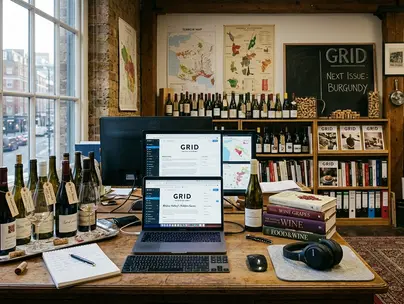
Photograph or retain the completed grid after the reveal and review it within a day or two, while the sensory sequence is still easy to reconstruct. Print out a blank tasting grid, fill in your final deductions for grape, region, and vintage in ink, and commit to your answer completely before unwrapping the bottle.