Why “Room Temperature” Warms Wine Too Far
The bottle arrives cool, the first pour tastes precise, and the glass beside the main course feels softer and more alcoholic. Between those sips, the wine has been exchanging heat with the room.
Traditional advice to serve red wine at “room temperature” makes more sense against a background of cooler domestic interiors. Stone buildings and underground cellars help explain that association, but storage and dining were distinct environments. An occupied dining room could be warmer than the cellar beneath it.
Follow the bottle through a modern service instead. As an illustrative scenario, wine stored at 12–14°C enters a dining room at 22–24°C, creating an initial temperature difference of 8–12°C. Once poured, it encounters room-temperature glassware, moving air, and surrounding surfaces. A candle or hot lamp can contribute radiant heat; the warm color of an LED alone tells you little about its thermal effect.
Wine begins warming as soon as its surroundings supply more heat than it loses. How quickly that happens depends on the pour, the glass, the starting temperature, and the table itself.
Before hosting a tasting, measure the air at glass-bowl height and beside the bottle’s resting place. Repeat after about 30 minutes of occupancy. Those readings give you a useful basis for service decisions, especially when the table sits near a kitchen pass.
How Heat Moves from the Dining Room into Your Pour
The temperature difference drives the process. Air transfers heat to the glass and exposed wine through convection. Energy crosses the glass wall by conduction, while surrounding surfaces exchange thermal radiation with the bowl. A room-temperature glass also supplies some stored heat immediately. Evaporation at the wine’s surface provides a competing cooling effect.
A small pour has relatively little thermal capacity. Using an approximate liquid heat capacity of 400 joules per degree Celsius for 100 mL of wine, raising that pour by 3°C requires roughly 1,200 joules, before accounting for the glass. The wine remaining in a fuller bottle has more liquid mass over which to distribute incoming heat.
A Calculated Warming Example
Assume wine starts at 10°C, the surroundings remain at 22°C, and the combined wine-and-glass system has a 30-minute thermal time constant. Newton’s warming model then gives approximately:
- After 5 minutes: around 12°C.
- After 10 minutes: close to 13.5°C.
- After 20 minutes: nearly 16°C.
These values are calculated illustrations under stated assumptions. For a glass held around the bowl, placed in sunlight, exposed to airflow, or given a different geometry, measure its temperature rather than applying this curve.
Starting temperature also changes the trajectory. In the same 22°C room, sparkling wine beginning at 7°C has a 15°C temperature difference; white wine at 10°C has a 12°C difference; a light red at 14°C has an 8°C difference. With otherwise comparable conditions, the colder wine initially receives heat faster, even while remaining colder in absolute terms.
For a useful home comparison, prepare separate 100 mL pours and measure them with an immersed probe at 0, 2, 5, 10, and 15 minutes. Keep the glass shape, starting temperature, and table position consistent. Measure the liquid directly rather than treating an infrared reading of the bowl as the wine’s temperature.
When Fruit and Floral Aromas Give Way to Alcoholic Heat
Warming can make a restrained wine more expressive. It can also shift attention away from citrus and flowers toward alcoholic warmth. Those changes deserve separate entries in your tasting notes.
As temperature rises, volatile compounds redistribute between the liquid and the headspace above it. Isoamyl acetate supplies a useful banana-associated reference; ethyl hexanoate is associated with fruity aromas. Among floral monoterpenes, linalool offers a floral reference and geraniol a rose-associated one. Their sensory contribution depends on their concentration and the surrounding wine.
A stronger aroma above the glass does not automatically mean the wine has rapidly exhausted that compound. Vapor–liquid partitioning and sensory interactions explain the experience more usefully than a compound’s boiling point. Meanwhile, ethanol’s increasing presence in the headspace can change the balance of the nose.
Compare Separate Samples at Serving Temperature
I use separate samples to keep the comparison focused on temperature rather than repeated swirling and time in the glass. Prepare the same wine at 8°C, 12°C, and 16°C, using identical glasses and equal pours. Treat these temperatures as comparison points.
Record four impressions independently:
- Fruit intensity: how clearly the fruit character presents itself.
- Floral intensity: whether floral notes remain distinct.
- Alcoholic heat: how strongly warmth or spirit-like aromas register.
- Perceived acidity: how fresh and defined the palate feels.
A sample may become more aromatic while feeling less balanced. Another may gain floral definition as its initial chill recedes. Separating these observations prevents “more aroma” from becoming an automatic vote for warmer service. For food pairings, repeat the comparison alongside a bite of the dish you intend to serve.
What Thin Crystal, Bowl Shape, and Pour Size Actually Change
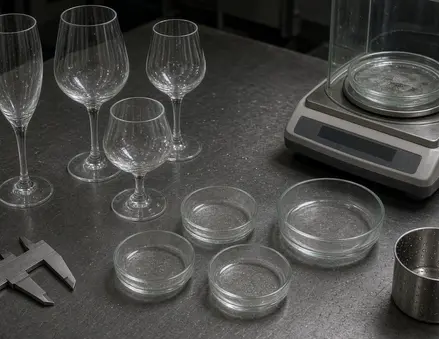
Featherweight crystal contributes less stored heat to chilled wine than a heavier glass at the same room temperature. That matters at the moment of pouring. Afterward, neither thin nor thick single-wall stemware provides substantial insulation from the room.
Bowl shape introduces another variable. A wide Burgundy bowl can expose a broader liquid surface than a narrow tulip, depending on where the pour sits. Compare the actual wine surface and wetted bowl area rather than relying on the glass’s name. For an illustrative circular surface, increasing the diameter from 5 cm to 8 cm increases the exposed area from approximately 20 cm² to 50 cm².
That geometry affects the interface available for evaporation and gas exchange, while the wetted glass provides another route for heat transfer. A broad rim alone cannot tell you how quickly the wine below it will warm.
The stem serves a simpler purpose: holding it removes sustained palm-to-bowl contact from the heat budget. It leaves the room’s contribution unchanged.
The Small-Pour Advantage
Less wine can warm faster per milliliter while still delivering a cooler final sip—because it spends less time in the bowl.
Compare a 75 mL pour consumed over 5–8 minutes with a 150 mL pour left for 15–20 minutes. These are service scenarios to test, rather than evidence that small pours intrinsically warm slowly. Their advantage comes from shorter exposure and replenishment from a temperature-managed bottle.
Choose a pour that suits the conversation and the course. A generous glass left untouched through a long discussion has a different thermal history from a modest measure finished alongside a few bites.
Move from Ice-Water Cooling to Dry Ceramic Holding
An ice bucket works well when the bottle needs active cooling. Water makes close contact with the bottle and transfers heat efficiently. An ice-and-water mixture containing unmelted ice sits near 0°C without added salt, creating a substantial cooling gradient against white wine intended for service at 10–12°C.
Leaving the bottle submerged after it reaches its chosen serving temperature keeps that cooling process going. Fruit and floral expression can become subdued as the wine gets colder.
Set Up a Measured Bottle-to-Glass Routine
- Check the wine first. Decide whether it needs cooling or simply protection from the room’s warmth.
- Use ice water for correction. Check the wine temperature at 3–5-minute intervals and remove the bottle at the chosen endpoint.
- Switch to passive holding. A pre-chilled, dry ceramic holder or double-walled sleeve slows the bottle’s return toward room temperature.
- Prepare the glasses. For aromatic whites, refrigerate clean, odor-free glasses for 10–15 minutes instead of frosting them in a freezer.
- Choose the resting place. Keep the bottle away from direct sunlight, candles, and the kitchen pass. Compare candidate positions with a thermometer.
The handoff matters: active cooling ends at the measured serving temperature; passive holding then slows further drift. Check the wine again before the next pour rather than assuming the holder has preserved its starting temperature.
At the table, you pour 60–75 mL of Riesling starting at 9–11°C into a narrow tulip glass. The bottle returns to its pre-chilled, dry ceramic holder. Over the next 5–8 minutes, you lift the glass by its stem, catch the citrus and floral notes, and finish the small measure beside the plate before reaching for the bottle again.